
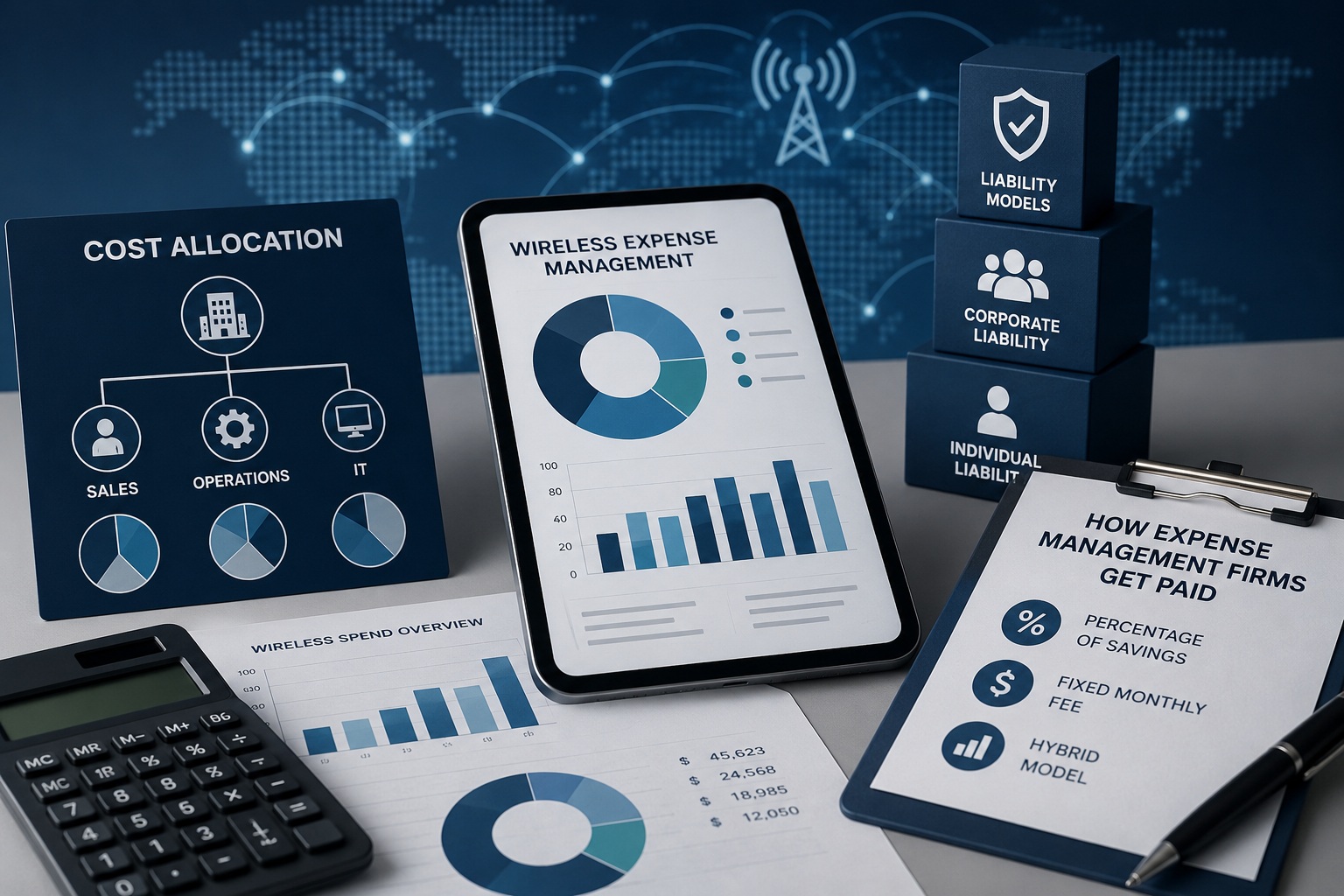
Two financial decisions shape how much control you have over corporate wireless: how you structure line ownership, and how you pay the firm that manages it. Get the first wrong and you lose visibility into your own spend; get the second wrong and the management fee eats the savings. Both deserve a clear-eyed look before you commit.
At Wireless Experts, we help finance leaders make both decisions with confidence. This guide explains the difference between corporate-liable lines and individual-liable lines, weighs reimbursement and stipend models against corporate plans, and lays out exactly how expense management firms charge including the shared-savings model we operate under.
Corporate-Liable vs. Individual-Liable Lines
A Corporate Responsibility User line is owned and paid for by the business. The company manages the account, receives invoices directly, sets usage policies, and assumes payment responsibility. This model provides strong visibility into spend, simplifies expense management, and lets you optimize plans across all users. An Individual Liable line, by contrast, is owned by the employee, who contracts directly with the carrier, pays the monthly bill, and may seek reimbursement for qualifying business use.
Individual-liable arrangements can work for certain roles, but they often produce inconsistent costs, limited reporting, and reduced control over wireless assets. We generally favor centralized corporate-liable environments because they deliver stronger financial oversight, better reporting, easier optimization, and more consistent management. For organizations moving employee-liable lines onto a corporate account, we manage the transition with minimal disruption reviewing plans and usage first, then optimizing each line on real business usage rather than an individual consumer plan.

Reimbursement, Stipends, or a Corporate Plan?
For a handful of employees using mobile devices occasionally, reimbursement can be practical. But as organizations grow, reimbursements become harder to manage, give limited visibility into actual costs, and make it difficult to optimize spend. A wireless stipend a fixed amount provided regardless of actual charges is simple to administer but offers little visibility and few optimization opportunities.
For organizations with meaningful mobile usage, we generally recommend a corporate-liable program. A centralized account gives you greater control over rate plans, billing, inventory, reporting, and policy enforcement while simplifying administration. It also lets you monitor costs, negotiate enterprise pricing, and optimize continuously. The reimbursement and stipend models tend to quietly cost more than they appear to once administration is factored in which is why auditing employee expense reports against carrier invoices and approved policies matters wherever those models remain in use.
How Expense Management Firms Charge
Pricing models vary across the industry. Some providers charge a fixed monthly management fee based on the number of lines or assets under management. Others use project-based fees for audits or implementation. And some including us offer contingency or shared-savings pricing, where compensation is tied to the verified savings actually delivered.
Under our model, savings audits are free and our ongoing optimization is built to produce measurable results, because that is what we are paid on. Rather than charging a large upfront consulting fee, we base compensation on the savings we generate which lets you evaluate the opportunity with minimal financial risk. When evaluating any provider, look past the pricing model itself to understand what is included, whether optimization is ongoing or one-time, how savings are measured, and what reporting you receive.
The Shared-Savings Model Explained

A shared-savings, or gain-share, model means the firm is compensated as a percentage of the verified savings it delivers not from upfront implementation or consulting fees. You pay only after measurable savings have been implemented, which creates strong alignment: both sides benefit from maximizing sustainable reductions, and if there are no savings, there is no fee.
In a typical engagement, we review invoices, analyze usage, identify optimization opportunities, and recommend changes that reduce recurring expense through billing corrections, rate plan optimization, elimination of unused services, or improved account management. Once verified, the agreed percentage is applied per the contract. For organizations that want measurable ROI without committing significant budget before seeing results, this structure is particularly attractive, because the provider only wins when you do.
Frequently Asked Questions
What Is Wireless Cost Center Allocation and Chargeback?
Cost center allocation and chargeback is a financial management process that assigns wireless expenses to the departments, business units, locations, or projects that actually use the services. Rather than treating wireless as one large corporate cost, you distribute charges based on device ownership, employee assignments, or predefined rules.
We help organize accounts so monthly invoices can be accurately allocated across the right cost centers. That improves budget accuracy, simplifies reporting, and encourages departments to manage their wireless resources more responsibly — visibility tends to change behavior.
Chargeback reports also give leadership clearer insight into departmental spending trends, making it easier to spot unnecessary costs, inactive lines, or inefficient rate plans. As organizations grow through expansion or acquisition, a structured allocation process creates consistent financial accountability across the enterprise.
Can Separate Business Units Share One Corporate Wireless Account?
Yes, when it aligns with your operational and financial goals. A centralized account simplifies carrier management, reduces administrative work, and provides better visibility into total spend. It also makes it easier to negotiate enterprise pricing, standardize policies, and monitor usage from one place.
Sharing one account does not mean losing financial control, which is the concern most finance teams raise. We recommend structuring the account so each business unit, department, or cost center still receives detailed reporting and chargeback information. That lets finance allocate costs accurately while benefiting from centralized management.
A well-designed strategy provides invoice validation, usage reporting, and ongoing optimization without disrupting operations. The objective is reducing administrative complexity while every business unit retains accountability for its own wireless expense.
How Do I Move Employee Personal Lines Onto a Corporate Account?
Moving employee-liable lines onto a corporate account is a common way to gain visibility, stronger cost control, and simpler management. The process generally involves coordinating with the carrier to transfer ownership of eligible lines, updating account authorizations, and confirming each employee’s current device and phone number stays active through the transition.
We manage this with minimal disruption. Before transferring lines, we review existing plans, usage patterns, and account structure to confirm moving the line actually supports your wireless strategy. Once transferred, each line can be optimized on real business usage rather than an individual consumer plan.
Centralizing service also improves reporting, invoice validation, policy enforcement, and ongoing cost optimization — while employees keep uninterrupted service and business continuity is preserved.
What Is a Corporate Responsibility User (CRU) vs. Individual Liable Line?
A Corporate Responsibility User line is owned and paid for by the business. The company manages the account, receives invoices directly, sets usage policies, and assumes payment responsibility. This model provides strong visibility into spend, simplifies expense management, and lets you optimize plans across all users.
An Individual Liable line, by contrast, is owned by the employee. They contract directly with the carrier, pay the monthly bill, and may seek reimbursement for qualifying business use. That can work for certain roles, but it often produces inconsistent costs, limited reporting, and reduced control over wireless assets.
We generally favor centralized corporate-liable environments because they deliver stronger financial oversight, better reporting, easier optimization, and more consistent management across the whole organization.
Should Employees Be Reimbursed for Wireless or Put on a Corporate Plan?
It depends on your size and operational requirements. For a handful of employees using mobile devices occasionally, reimbursement can be practical. But as organizations grow, reimbursements become harder to manage, give limited visibility into actual costs, and make it difficult to optimize spend across the business.
For organizations with meaningful mobile usage, we generally recommend a corporate wireless program. A centralized account gives you greater control over rate plans, billing, inventory, reporting, and policy enforcement while simplifying administration. It also lets you monitor costs effectively, negotiate enterprise pricing, and optimize continuously.
Rather than processing individual reimbursements every month, you gain a standardized environment that supports long-term cost reduction and operational efficiency. The reimbursement model tends to quietly cost more than it appears to once administration is factored in.
What Is a Wireless Stipend vs. Corporate-Liable Program?
A wireless stipend is a fixed amount an employer provides to help cover business-related mobile expenses. Employees keep their own personal accounts, and the company reimburses a set amount regardless of actual charges. It is simple to administer but offers limited visibility into spend and few opportunities for optimization.
A corporate-liable program places wireless service under the company’s account. The organization owns or manages the lines, receives invoices directly, and has full visibility into usage, billing, and inventory. That supports centralized reporting, invoice validation, policy enforcement, and ongoing expense management.
We generally promote corporate-liable programs for organizations seeking long-term cost control, consistent governance, and enterprise-wide optimization — while acknowledging that stipends can still suit businesses with limited mobile requirements.
How Do I Audit Wireless Expense Reports from Employees?
Start by establishing clear policies for what is reimbursable and requiring documentation for every claim. Then compare submitted reports against carrier invoices, corporate accounts, and approved reimbursement policies to verify charges are legitimate and business-related. Pay particular attention to international roaming, premium services, duplicate reimbursements, and personal usage outside company guidelines.
For corporate-liable programs, auditing should also confirm each line is assigned to the correct employee, review usage trends, and verify employees are on the most appropriate rate plans.
We emphasize ongoing expense management rather than one-time reviews, helping identify billing discrepancies, optimize plans, and improve reporting accuracy. Regular audits reduce unnecessary spend, simplify accounting, and give management better visibility into wireless costs across departments while ensuring employees receive appropriate service for their responsibilities.
How Much Does a Wireless Expense Management Service Cost?
It depends on the provider’s engagement model, the size of your environment, and the scope of services required. Rather than charging a large upfront consulting fee, many specialized firms — including those working on a contingency basis — base compensation on the savings they actually deliver. That lets you evaluate potential savings with minimal financial risk.
Our approach emphasizes measurable cost reduction and ongoing optimization rather than selling software or fixed-fee consulting. Depending on your needs, services may include invoice auditing, rate plan optimization, carrier contract analysis, inventory management, reporting, and ongoing support.
Companies with larger deployments often realize the greatest value, because even modest improvements across hundreds or thousands of lines generate substantial recurring savings. The best starting point is a wireless savings assessment to establish the expected return before any engagement begins.
How Do Wireless Cost Reduction Firms Get Paid?
Most independent firms use a performance-based model rather than charging significant upfront fees. Compensation is tied to the measurable savings generated, which aligns both parties’ interests — the firm only succeeds when it delivers verified results.
Our model emphasizes demonstrating savings through audits, optimization, and ongoing expense management rather than requiring disruptive changes. After reviewing invoices, contracts, and usage data, we identify opportunities such as rate plan optimization, billing corrections, removal of unnecessary services, and contract improvements. If you approve the recommendations and savings are achieved, the agreed compensation is calculated per the engagement terms.
This structure reduces financial risk for clients and encourages continuous optimization rather than one-time consulting recommendations. It also means our incentives stay pointed at finding every genuine savings opportunity, not billing hours.
What Is a Shared-Savings Model for Cost Reduction?
A shared-savings model is a performance-based pricing approach where the firm is compensated as a percentage of the verified savings it delivers. Rather than paying large consulting fees before results appear, you pay only after measurable savings have been implemented. That creates strong alignment — both sides benefit from maximizing sustainable reductions.
In a typical engagement, we review invoices, analyze usage, identify optimization opportunities, and recommend changes that reduce recurring expense. Savings may come from correcting billing errors, optimizing rate plans, eliminating unused services, or improving account management. Once verified, the agreed percentage is applied per the contract.
This model lets organizations pursue optimization with minimal upfront commitment while keeping the provider focused on delivering genuine, measurable value rather than simply producing a report.
Get Your Free Wireless Savings Audit
Ready to see what your organization could save? Wireless Experts offers a free, no-obligation wireless savings audit — a detailed, line-by-line review of your carrier invoices, rate plans, and usage. You keep your existing carrier, phone numbers, and devices, and there is no upfront cost. Contact us at wirelessexperts.us to request your free audit and savings report.